Mayoke (魔除け)
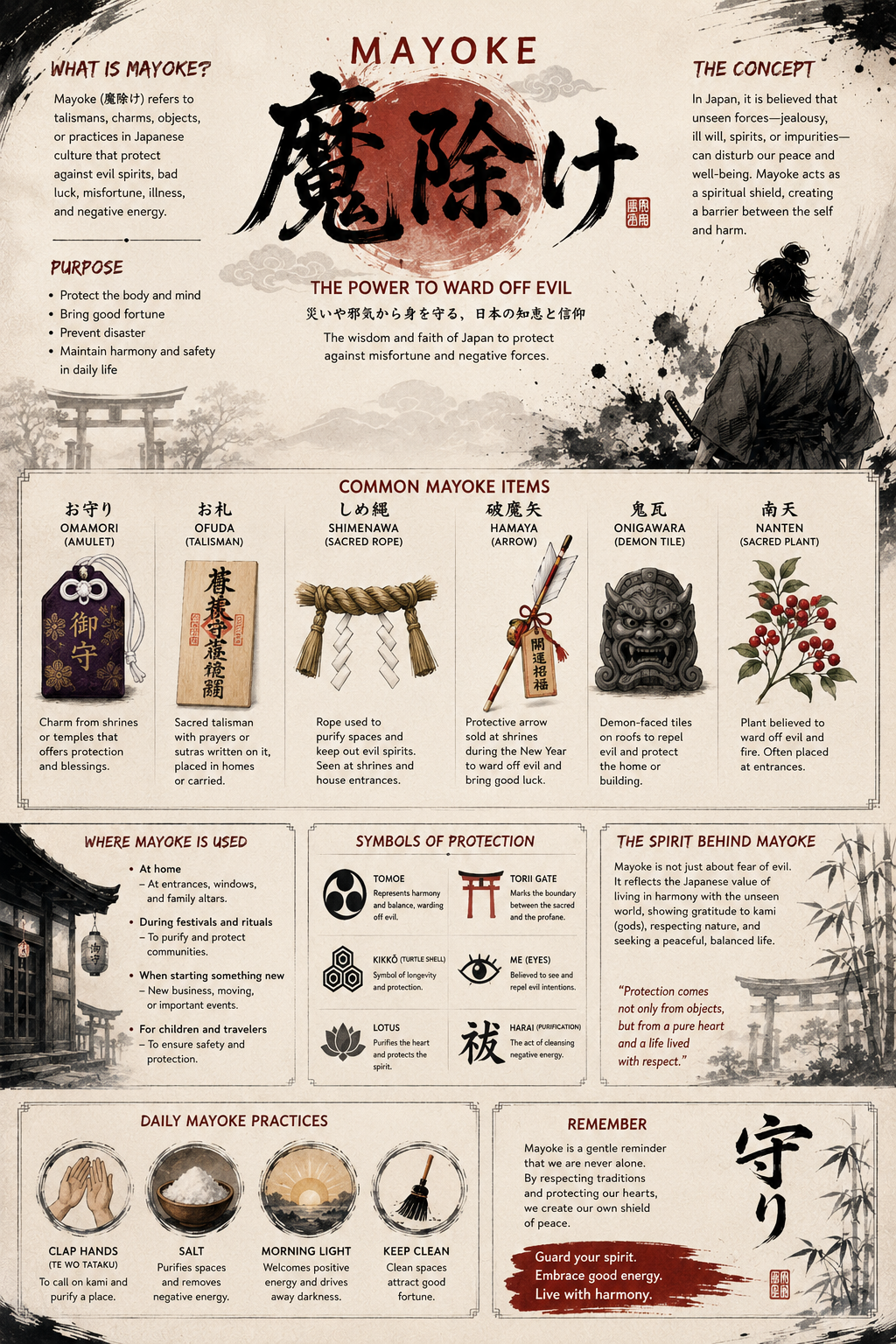
In Japanese culture, a Mayoke (魔除け) is a broad category of protective talismans, charms, or rituals designed to ward off evil spirits, disasters, and misfortune. The word itself is derived from Ma (evil/demon) and Yoke (warding off/protection).
Unlike a general good luck charm (Omamori), which is often carried to invite a specific positive outcome, a Mayoke is specifically a defensive barrier.
- Common Types of Mayoke
Mayoke come in many forms, ranging from items you carry to architectural features of a home:
- Ofuda: Large paper or wooden household amulets issued by Shinto shrines or Buddhist temples. They are often placed above doorways or on a home altar (Kamidana) to protect the entire family.
- Hamaya (Demon-Breaking Arrow): Decorative arrows sold at shrines during the New Year. They are meant to "shoot down" evil influences entering the home.
- Shimenawa: Sacred rice-straw ropes with zigzag paper streamers (shide) seen at shrine entrances or around ancient trees. They mark a boundary between the profane world and a sacred, protected space.
- Onigawara (Ogre Tiles): You will often see these fierce-looking gargoyle-like tiles on the roof ends of traditional Japanese buildings. Much like European gargoyles, they are intended to scare away malignant spirits.
- Colors and Symbols
The aesthetics of a Mayoke are rarely accidental. Specific elements are believed to have inherent "anti-evil" properties:
- The Color Vermilion (Shu-iro): This bright reddish-orange color, seen on Torii gates, is traditionally believed to repel demons and diseases.
- Salt (Morigio): Small piles of salt placed at the entrance of a business or home act as a Mayoke to purify the space and prevent "bad energy" from entering.
- Fierce Expressions: Figures like the Lion-Dog (Komainu) or the Nio Guardians use intimidating faces to strike fear into evil entities.
- Cultural Significance
The concept of Mayoke is deeply rooted in the Shinto belief of Kegare (impurity). In Japanese thought, misfortune is often seen as a form of spiritual "dirt" or "clutter" that attaches itself to people or places. A Mayoke acts as a filter or a shield, ensuring that the environment remains "clean" and harmonious.
Here is the historical evolution and significance of these practices:
1. The Heian Period: The Golden Age of Onmyōdō
During the Heian period (794–1185), Mayoke was a matter of state security. The Emperor and the aristocracy relied on Onmyōji (Yin-Yang masters) to protect the capital, Kyoto.
- Geomancy (Feng Shui): The city of Kyoto itself was designed with mayoke in mind. The Enryaku-ji Temple was built on Mt. Hiei to the northeast to guard the "Demon Gate" (Kimon), protecting the city from spiritual intrusion.
- Ritual Purification: State-sponsored rituals like Harae were performed to cleanse the entire population of "spiritual pollution" (kegare), which was believed to cause social unrest and disease.
2. The Influence of Shinto and Purity
The historical significance of Mayoke is deeply rooted in the Shinto concept of Kegare (withered spirit/impurity).
- Defensive Living: Historically, death, disease, and childbirth were seen as sources of impurity. Mayoke objects served as "barriers" (kekkai) to keep these impurities from spreading or attracting malevolent entities.
- The Power of Nature: Natural objects with sharp edges or strong scents—like holly leaves (hiiragi) or the heads of dried sardines—were used historically during Setsubun to physically and spiritually puncture the eyes of demons.
3. Social Control and Community Identity
During the Edo period (1603–1868), Mayoke became more commercialized and accessible to the common people, serving two major functions:
- Psychological Resilience: In an era before modern medicine, carrying an omamori or placing an ofuda gave people a sense of agency over uncontrollable events like smallpox outbreaks or fires.
- Architectural Heritage: You can still see "Oniwara" (Ogre Tiles) on the roofs of historical buildings. These were intended to turn the image of a demon back upon itself, using the "frightening" to scare away the "evil."
4. Cultural Symbolism of Color
Historically, the use of Vermillion (Shinnō) in shrines and mayoke items was significant because it was made from cinnabar (mercury sulfide).
- Preservation: Beyond its striking color, cinnabar was a preservative. This dual nature—physically preventing rot and spiritually preventing evil—solidified red as the ultimate color of protection in the Japanese psyche.
| Period | Primary Focus of Mayoke | Common Method |
|---|---|---|
| Ancient | Survival/Plagues | Salt, Fire, and Water rituals. |
| Heian | Political/State Security | Geomancy and professional Exorcists (Onmyōji) |
| Edo | Household/Personal Safety | Printed talismans (Ofuda) and amulets. |